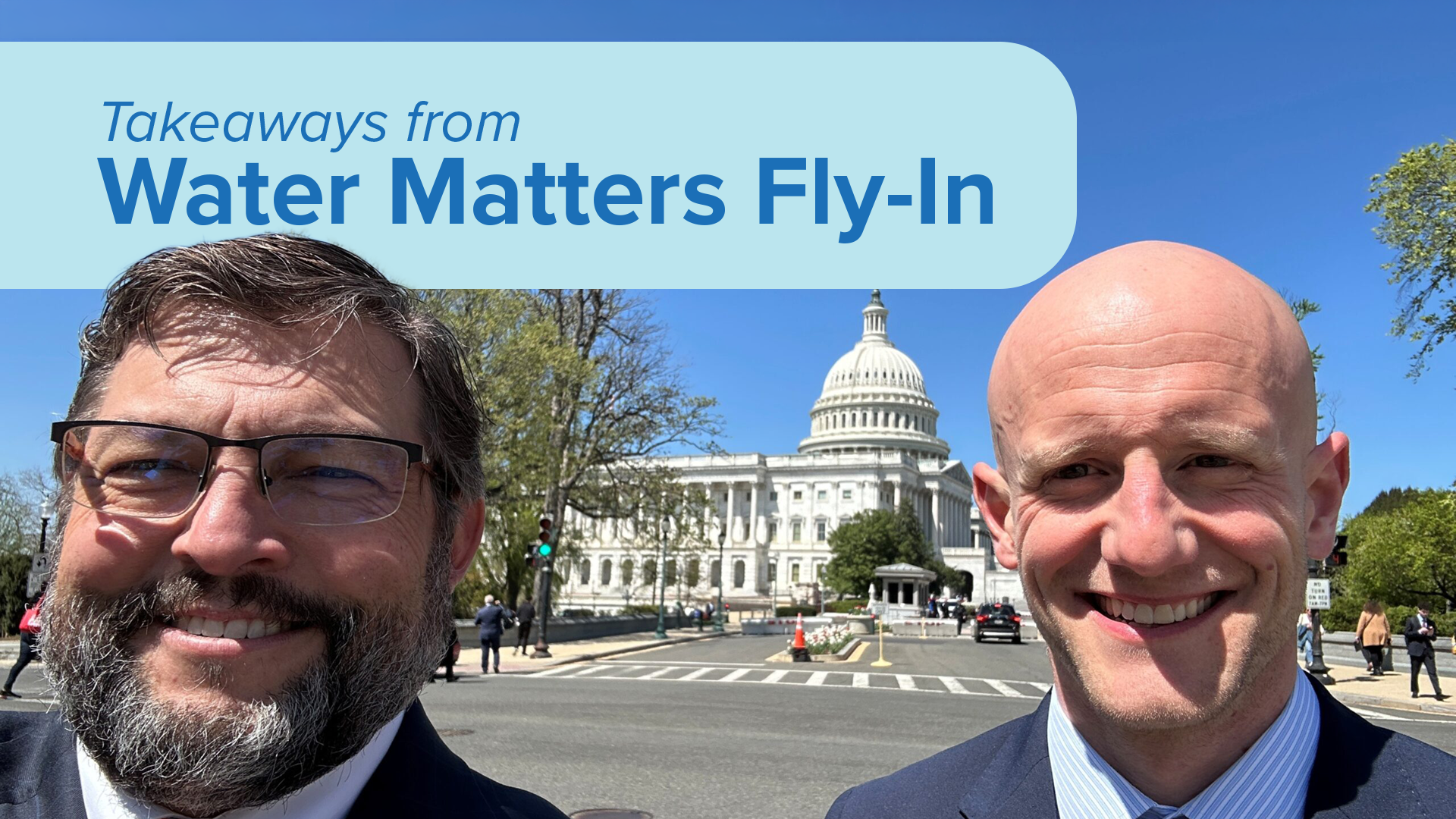
Since 2001, the Government Affairs Office of the American Water Works Association (AWWA) hosts an event known as the Water Matters Fly-In in Washington, DC. The event represents a significant initiative of the Water Utility Council of AWWA, which is charged with providing oversight of the government affairs program. The purpose of the Water Matter Fly-In is to have representatives of AWWA from each State meet with their respective Congressional Delegation members to advocate for support on issues and legislation that impact the water sector.
This year, the event was held on April 13-15. The following is a summary of the issues that were the focus of discussion with members of Congress and staffers:
- Funding and Appropriations:
 Members of Congress were asked to support reauthorization of the Drinking Water State Revolving Fund (DWSRF) and Clean Water State Revolving Fund (CWSRF) loan programs at a level of $3.25 billion each, and the Water Infrastructure Finance and Innovation Act (WIFIA) at $80 million. Since the Federal appropriation awarded to the WIFIA program is intended to cover a potential loan default, which is relatively uncommon in the water sector, the program is capable of providing loan authority in the range of $8 billion (100 times $80 million) to communities to supplement the State Revolving Fund programs and support investment in water and wastewater systems.
AWWA recently published a report entitled Beyond the Replacement Era. The document highlights increased concerns regarding affordability as utilities address competing challenges related to aging assets, regulatory compliance, risk mitigation via investments in overall system resilience strategies, and community growth that may require the development of additional water supplies. The report identifies the need for water system investment in the range of $2.1 to $2.4 trillion by 2050, reflecting an annual spend of about $90 billion. The information provided in the document served as effective talking points in support of the requested funding levels of the DWSRF, CWSRF, and WIFIA programs.
- Low Income Assistance:
 Many utilities have needed to raise rates to adequately fund necessary capital improvements and rising costs associated with operations and maintenance, placing increased financial strain on those with low or fixed incomes. The resulting affordability issue could potentially lead to nonpayment of utility bills, which leads to the shutoff of an essential service and decreased revenue. Congressional support for H.R. 4733 was requested to reestablish the Low-Income Household Water Assistance Program (LIHWAP) that provided financial assistance for the purpose of paying utility bills during the COVID pandemic.
 - PFAS Liability Exemption:
 Per- and polyfluoroalkyl substances (PFAS) represent an emerging contaminant group for water and wastewater utilities. PFAS are often referred to as “Forever” chemicals because of their resistance to decomposition. Based on increased sampling and testing efforts, have been referred by some as “Anywhere and Everywhere” chemicals. Given the ubiquitous presence of perfluorooctanoic acid (PFOA) and perfluorooctanesulfonic acid (PFOS), the United States Environmental Protection Agency (USEPA) designated these two chemicals as hazardous substances under the Comprehensive Environmental Response, Compensation, and Liability Act (CERCLA). CERCLA deals primarily with remediation of sites that are contaminated by hazardous substances. As passive receivers of PFAS and with regulations mandating the removal of specific PFAS from water, utilities are inherently and unfairly at risk of being held liable under CERCLA for cleanup costs related to PFAS contamination caused by the disposal of waste streams and spent filter media or ion exchange resin. For this reason, attendees asked Congressional Members to support H.R. 1267, the Water Systems PFAS Liability Protection Act, which would direct liability for cleanup activities to those responsible for the pollution.
 - Cybersecurity:
 Water systems continue to be at increased risk of cyber threats and attacks, making cybersecurity more important than ever. In response, Congressional Members were asked to support seven bills aimed at providing funding, technical assistance, training, and information to encourage the implementation of best practices to strengthen cybersecurity. One of the proposed bills, H.R. 2594, would establish a third-party organization tasked with the responsibility of defining minimum cybersecurity requirements that would be appropriate for utilities based on system size and risk. Oversight of the nongovernmental entity would be provided by the USEPA.
I have attended the AWWA’s Water Matters Fly-In for many years and enjoy the opportunity to learn about emerging water industry issues and meet with congressional delegates. If you have questions regarding the Fly-In or topics of discussion, contact me at Nate.Weisenburger@ae2s.com.