
As communities expand wastewater treatment capacity, regulatory requirements can become as complex as the project design/engineering itself. Among the most nuanced requirements is anti-degradation, also known as non-degradation, a policy rooted in the Clean Water Act (CWA) that is increasingly relevant for growing systems.
While technology-based effluent limits (TBELs) such as biochemical oxygen demand (BOD) and total suspended solids (TSS) are familiar to most operators and engineers, anti-degradation operates differently. Rather than focusing on what level of treatment technology must be applied, it asks a broader question: Will the proposed discharge increase from a wastewater treatment facility degrade ambient water quality?
While Federal law establishes the overall framework, it is important to note that anti-degradation rules are generally implemented at the State level, and requirements vary. The discussion below reflects how anti-degradation is applied in Minnesota. Other states may structure their analyses differently, apply different economic tests, or interpret regulatory flexibility in distinct ways.
The Regulatory Framework
Wastewater discharge permits are generally shaped by four primary regulatory drivers:
- TBELs – Established performance standards such as secondary treatment requirements for BOD and TSS.
- Water Quality-Based Effluent Limits (WQBELs) – Limits derived from State water quality standards to protect the designated beneficial uses of the receiving waters to which effluent will be discharged.
- Total Maximum Daily Loads (TMDLs) – Watershed-specific pollutant caps for impaired waters.
- Anti-Degradation Requirements – Protections to maintain existing water quality when new or expanded discharges are proposed.
“Anti-degradation comes into play most often when a facility seeks to increase its treatment design flow or mass loading,” says Scott Schaefer, PE, AE2S Practices Director and Wastewater Engineer. “Even if a facility is meeting its current effluent permit limits, expanding capacity can trigger a requirement to demonstrate that receiving water quality will not be degraded – even if in-stream water quality standards are maintained with the proposed capacity expansion and the existing discharge concentrations.”
How Anti-Degradation Works
Anti-degradation analyses typically include three major components:
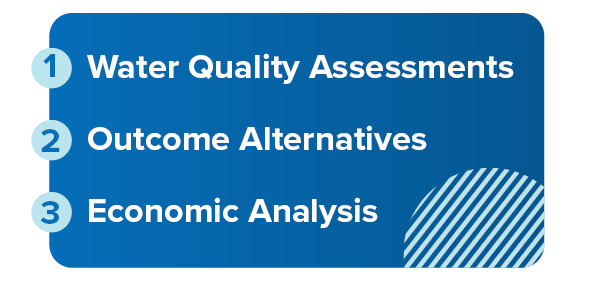
The water quality component assesses the following:
- Existing in-stream water quality of the receiving stream
- Relevant pollutants of concern
- Existing permitted discharge levels
- Proposed discharge flow volume, effluent concentrations, and corresponding mass loads to the receiving stream
The analysis focuses on critical conditions of the receiving stream, which are often low-flow scenarios such as seven-day, 10-year low stream or river flow (7Q10). In cases where a receiving stream has little or no background flow, effluent limits may effectively become “end-of-pipe” limits, since dilution flow is not available.
If a TMDL is already in place for the receiving stream, the limits established in the TMDL often govern and reduce the flexibility of the anti-degradation review. For other parameters not yet included in a TMDL, a detailed reasonable potential analysis (RPA) determines whether further scrutiny is required.
Once the pollutants of concern are determined, each pollutant of concern is analyzed independently; however, there is also an opportunity during the alternatives analysis stage to “bundle” pollutants that have interrelated treatment approaches. The alternatives evaluation stage of the anti-degradation analysis can potentially result in additional treatment steps being required or selection of alternatives with enhanced treatment performance as long as “affordability,” as defined by the anti-degradation analysis procedures, can be maintained.
Increasingly, communities are also analyzing emerging or anticipated standards such as nitrate before they become formal water quality criteria. Proactively incorporating these parameters can avoid reopening anti-degradation reviews when regulations evolve.
If a proposed expansion could lower water quality, the applicant must evaluate feasible alternatives and their associated costs. This may include:
- Enhanced treatment technologies
- Relocation of discharge points
- Source control strategies
- Non-discharge alternatives (e.g., increased reuse)
Economic feasibility of the alternatives must also be considered. Like a variance analysis, applicants must demonstrate whether more protective alternatives are technically achievable and economically affordable. Affordability metrics, which are often based on median household income, can play a significant role in determining what constitutes economically “affordable.” This portion of the review can strongly influence project design and delivery decisions.
Special Designations and Receiving Waters
Anti-degradation analysis becomes more stringent when discharging effluent into high-quality waters. For example, discharges to waters designated as Outstanding Resource Value Waters (ORVW), such as portions of the Mississippi River, face additional scrutiny on new or expanded loading.

These designations may require facilities to discharge into alternative receiving waters, even if those waters have a lower “assimilative” capacity to integrate the discharge. Historic infrastructure decisions often reflect these regulatory boundaries, which continue to shape modern wastewater treatment facility expansions.
Interaction with Other Environmental Reviews
Treatment capacity increases frequently trigger additional regulatory processes beyond the National Pollution Discharge Elimination System (NPDES) permit. In Minnesota for example, expansions may require an Environmental Assessment Worksheet (EAW), which evaluates potential impacts on air quality, noise, climate, and other environmental factors.
Air permitting requirements have become more rigorous over time. Facilities may need to perform detailed air dispersion modeling to demonstrate compliance, even if no air permit is ultimately required. A State may use different environmental review mechanisms, or potentially none, depending on environmental policy statutes. These overlapping regulatory layers can extend project timelines and complicate implementation.
Chloride: A Regulatory Challenge

Chloride has become one of the most challenging pollutants in anti-degradation reviews, particularly in northern States where the use of road salt and/or residential water softeners is common. Where receiving streams lack dilution, chloride limits are often set at end-of-pipe concentrations. Since treatment technologies for chloride removal are costly and energy-intensive, regulatory compliance frequently relies on source reduction strategies, including:
- Road salt optimization programs
- Public education campaigns
- High-efficiency water softener ordinances
- Evaluation and/or implementation of centralized softening of the community’s drinking water
The economic and technical constraints associated with chloride make it a frequent focal point of anti-degradation, variance, and/or compliance schedule discussions.
Evolving Regulatory Expectations
Anti-degradation reviews are becoming more data-intensive and forward-looking. Regulators increasingly expect wastewater systems to demonstrate long-term planning consistency and to consider build-out scenarios, emerging pollutants, and climate resilience. However, the structure, documentation requirements, and degree of flexibility remain specific to each State. Utilities planning wastewater treatment facility expansions must work closely with their respective State permitting authority to understand applicable thresholds and expectations.
Anti-degradation is not simply an administrative step in permitting. It is a substantive, technical evaluation that can shape facility design, discharge locations, technology selection, and rate impacts.
As communities continue to grow and water quality standards evolve, anti-degradation will likely become a more common and consequential element of wastewater permitting. Understanding its structure, documentation requirements, and economic considerations is essential for utilities planning capacity expansions in today’s regulatory environment.
If you would like to explore anti-degradation in wastewater permitting further, contact Scott Buecker, AE2S Wastewater Practice Leader.