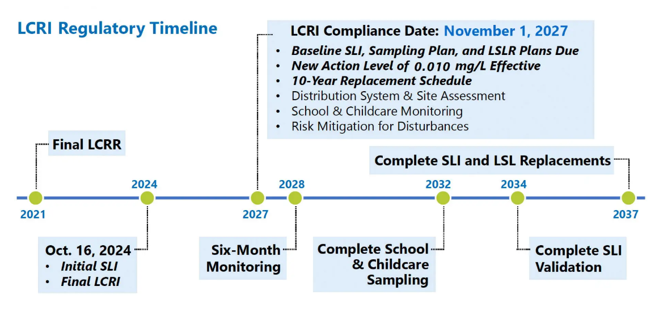
When the final Lead and Copper Rule Improvements (LCRI) rule was announced in October 2023, the deadline to create a baseline inventory of the pipe materials seemed far in the future. As of this month, the clock is ticking to finalize your system’s service line inventory. The U.S. Environmental Protection Agency (USEPA) wants your completed inventory in less than a year – by November 1, 2027. The following provides an overview of the upcoming LCRI deadlines.
Customer Notifications
Water systems are required to send notifications to all customers served by an unknown, lead, or galvanized requiring replacement service line in the system’s inventory no later than 30 days after the deadline for each annual inventory update under the LCRI. These annual notifications are required until the line is confirmed non‑lead through identification or replacement. The notifications are required to include the service line classification, mandatory USEPA health effects language, and steps to reduce lead exposure.
Replacement Plans
Under the LCRI, the inventories have been updated annually since 2024. Systems with at least one lead, galvanized requiring replacement, or unknown service line must create a replacement plan that includes a strategy to prioritize replacement considering community-specific factors, such as populations disproportionately impacted by lead among a number of other items. Water systems are required to make the inventories and replacement plans available to the public. Partial service line replacement of lead and galvanized requiring replacement is not allowed, and lead connectors must be removed when encountered. All lead and galvanized service lines downstream of lead need to be replaced by December 31, 2037.
Sampling & Monitoring
Beginning in 2028, most systems will be required to revert back to standard monitoring for lead and copper. The LCRI rule also emphasizes sampling from sites with lead service lines. For sites with lead service lines or lead premise plumbing, water systems are required to collect and analyze the first-liter and fifth-liter samples and use the higher of the two values when determining compliance. Systems must notify sample site households of lead and copper monitoring results within three business days of receiving the results.
Between January 2025 and November 2027, if a system has adopted the LCRI sampling protocol including but not limited to sampling from the new tier levels, the first and fifth liter sampling protocol and their 90th percentile is less than the LCRI action level of 10 μg/L for their next required sampling period, systems will not have to revert to standard monitoring. If the system does not meet the LCRI 90th percentile for lead or copper, the system must begin standard monitoring after November 1, 2027.
If a water system’s 90th percentile lead level exceeds 10 μg/L, the system is required to issue a Tier 1 Public Notification for the lead action level exceedance within 24 hours to inform the public. The system must also install or adjust its reporting and public notification for corrosion control treatment. Water systems that exceed the lead action level three or more times out of a five year rolling period must provide filters that are certified to reduce lead to customers in the service area upon request and conduct additional community outreach.
If you have questions about the LCRI rule compliance, check out the Perspectives and Insights section of AE2S.com or contact Nate Weisenburger, AE2S Drinking Water Practice Leader.